Keap (formerly Infusionsoft) and GoHighLevel are both all-in-one CRM and automation platforms aimed at small businesses, so they often end up on the same shortlist. They come from different directions, though. Keap grew out of email marketing automation and sales tools for small businesses. GoHighLevel grew out of agency needs: funnels, SMS, calendars and managing many client accounts. Here is how they compare in practice.
Note: both platforms update features and pricing regularly. Use this as a guide to the differences in approach, and confirm current plans on each vendor's website.
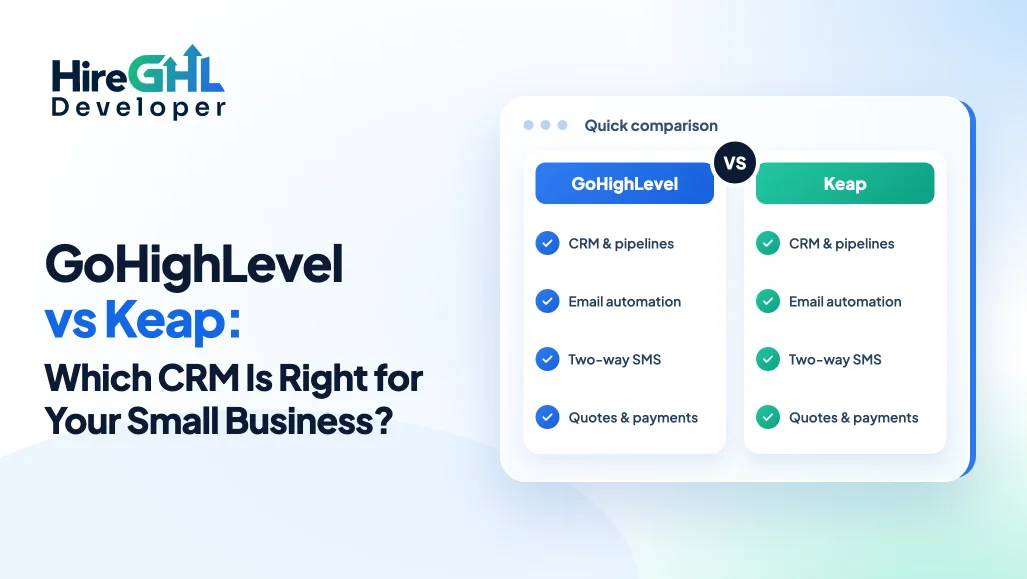
Quick comparison
| Capability | GoHighLevel | Keap |
|---|---|---|
| CRM & pipelines | Yes | Yes, strong for small sales teams |
| Email automation | Yes, visual workflows | Yes, long-standing strength |
| Two-way SMS & calling | Native, deeply integrated | Available, more limited |
| Funnels & websites | Full builder included | Landing pages; more limited |
| Calendars & booking | Advanced, multiple calendars and team routing | Basic appointments |
| Quotes, invoices & payments | Yes | Yes, a strength |
| Reputation / review requests | Built in | Limited / via integrations |
| Courses & memberships | Built in | Not a core feature |
| AI chat and voice agents | Built in | AI writing and assistant features |
| Unlimited client sub-accounts | Yes (agency plans) | No |
| Resell as your own software | Yes (SaaS mode) | No |
Pricing model
The structural difference matters more than any single price:
- GoHighLevel charges a flat monthly subscription, with SMS, calls, email and AI billed by usage. Contact count does not raise the subscription price, which suits businesses with large lists.
- Keap has historically priced by plan level, number of contacts and number of users. As your list or team grows, costs rise with it.
For a business with a few thousand contacts and one or two users, the difference may be small. For a business with tens of thousands of contacts, or an agency serving many clients, GoHighLevel usually works out significantly cheaper.
Where Keap shines
- Mature automation for sales follow-up. Keap has deep experience in email-based nurture and sales pipelines for small businesses.
- Quotes, invoices and payments are well integrated for service businesses that sell through proposals.
- Simpler scope. For a solo business owner who mainly needs CRM, email automation and invoicing, Keap's focused feature set can feel easier.
- Established ecosystem of certified partners and integrations built over many years.
Where GoHighLevel shines
- SMS-first follow-up. Speed-to-lead texting, missed-call text back and two-way conversations are central to GoHighLevel, and these are what local and service businesses need most.
- Everything in one place. Funnels, websites, calendars, reviews, memberships, AI chat and the CRM share one database and one bill.
- Agency features. Sub-accounts, snapshots and SaaS mode make it the default choice for marketing agencies.
- Booking-driven businesses. Clinics, med spas, home services and real estate benefit from advanced calendars and reminders.
- Pricing that does not penalise list growth.
Which should you choose?
| Your situation | Better fit |
|---|---|
| Marketing agency managing multiple clients | GoHighLevel |
| Local service business that lives on calls, texts and bookings | GoHighLevel |
| Business with a large contact list | GoHighLevel |
| Solo consultant needing CRM, email nurture and invoicing | Either; Keap may feel simpler |
| Business already deeply invested in Keap campaigns that work well | Stay unless costs or missing features hurt |
| Business wanting funnels, courses and reviews without extra tools | GoHighLevel |
Switching from Keap to GoHighLevel
If you decide to move, the process follows the same steps as any migration to GoHighLevel, with a few Keap-specific points:
- Audit tags ruthlessly. Long-running Keap accounts often have hundreds of tags, many obsolete. Map only the ones that drive segmentation or automation.
- Redesign campaigns rather than copying them. Keap campaign builder logic does not translate one-to-one. Rebuild the intent of each campaign using GoHighLevel workflows, adding SMS where it helps.
- Plan payments carefully. Active subscriptions and payment plans need a clear plan for continuity, usually by keeping billing running in your payment processor while access and follow-up move to GoHighLevel.
- Keep history you need for reference. Export notes and order history even if you do not import all of it.
- Authenticate email before sending and warm up gradually to protect deliverability.
The bottom line
Keap is a solid, focused choice for small businesses centred on email nurture, sales follow-up and invoicing. GoHighLevel is the stronger choice for agencies, booking-driven businesses and anyone who wants SMS, funnels, calendars, reviews and AI in one platform at a flat price. For a wider comparison, see GoHighLevel vs ClickFunnels vs HubSpot.
Thinking about switching? Our team handles Keap to GoHighLevel migrations end to end, with a written plan before we start.
Frequently asked questions
Is GoHighLevel cheaper than Keap?
Often, especially as your contact list grows. GoHighLevel charges a flat monthly subscription with usage-based messaging costs, while Keap's pricing has historically scaled with contacts and users. Compare current plans for your list size and team before deciding.
Is Keap easier to use than GoHighLevel?
Many small business owners find Keap's focused CRM and sales tools simpler at first. GoHighLevel does more, so it has a steeper learning curve, but a clean setup with documented workflows makes it manageable for most teams.
Can I migrate from Keap to GoHighLevel?
Yes. Contacts, tags and custom fields can be exported and imported. Campaigns, automations and forms need to be rebuilt in GoHighLevel. Plan extra time if your Keap account has years of complex campaign logic.
Which is better for agencies, Keap or GoHighLevel?
GoHighLevel. It was built for agencies with unlimited client sub-accounts, snapshots and SaaS mode. Keap is designed for individual small businesses rather than agencies managing many clients.